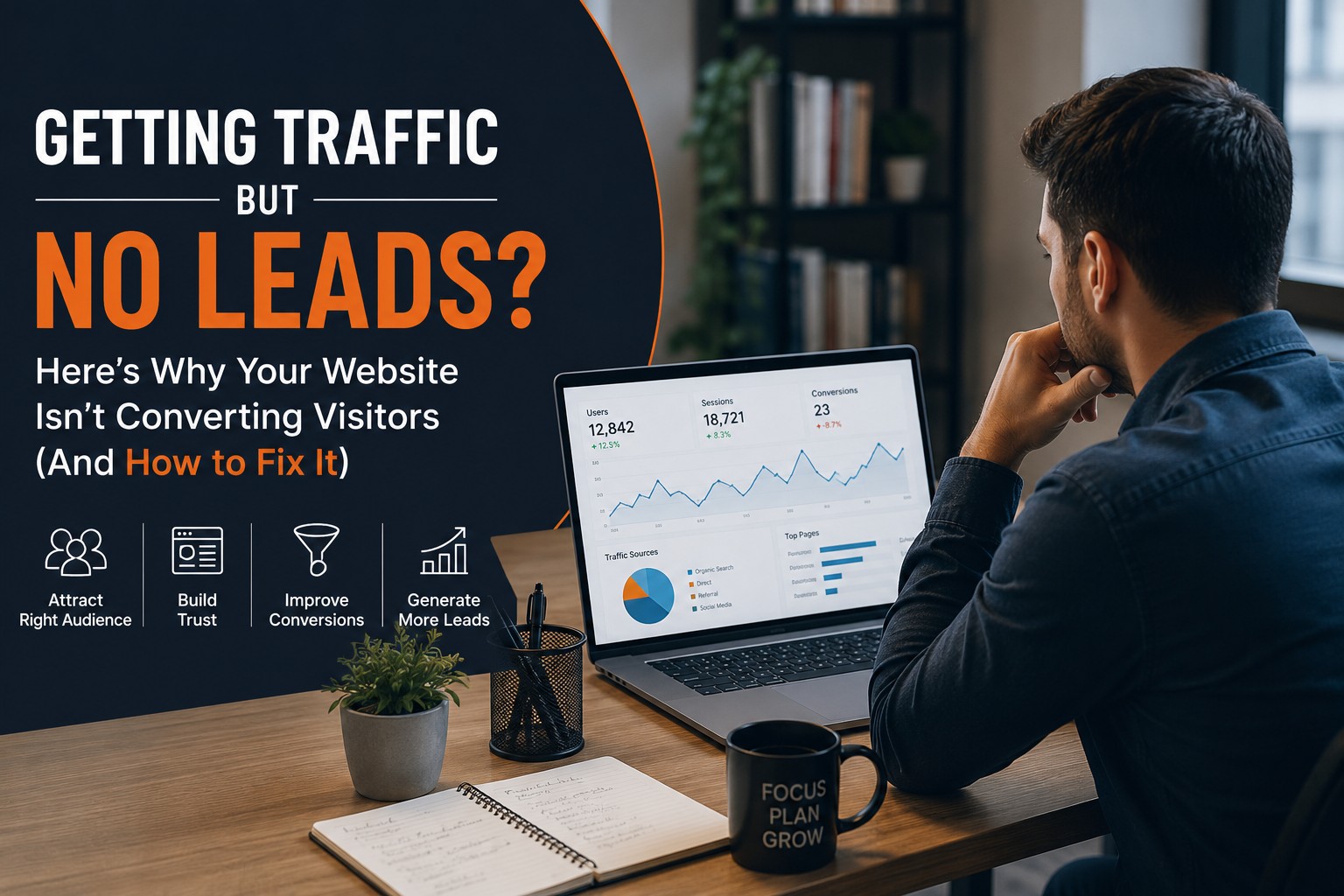
Seeing your website traffic increase feels good. More people are finding your business, visiting your pages and spending time on the site. But after checking your inbox, contact form or call history, you may notice that hardly anyone is actually reaching out.
This is a common problem. A website can attract hundreds or even thousands of visitors and still generate very few genuine enquiries. Traffic alone does not grow a business. The website also needs to build trust, answer the right questions and make the next step easy for the visitor.
In most cases, the problem is not a lack of visitors. It is the experience those visitors have after landing on the website.
Traffic and Leads Are Not the Same Thing
Website traffic tells you how many people visited your site. It does not tell you whether those visitors were interested in buying, whether they understood your services or whether they trusted your business enough to contact you.
A person may visit your website for many reasons. They may be researching a topic, comparing prices, looking for a job or simply checking your company after seeing its name somewhere else.
This means that more traffic does not automatically result in more sales. The quality of the visitor and the quality of the website experience both matter.
A successful website does more than attract attention. It helps the right visitor feel confident about taking action.
Your Website May Be Attracting the Wrong Audience
One of the first things to check is where your traffic is coming from. A website may rank for keywords that bring visitors but not potential customers.
For example, an SEO agency may receive traffic from people searching for “what is SEO” or “how to learn digital marketing.” These visitors can increase traffic numbers, but they may not be looking to hire an agency.
Commercial searches are usually more valuable. Someone searching for “local SEO services in Noida” or “SEO company for small business” is much closer to making a decision.
Look at Search Intent, Not Just Search Volume
Before creating a page or targeting a keyword, think about what the person actually wants.
- Are they looking for general information?
- Are they comparing different service providers?
- Are they ready to contact a company?
- Are they only searching for a free solution?
A smaller number of highly relevant visitors can generate more business than a large number of visitors who have no intention of buying.
Your Message Is Not Clear Enough
When someone lands on your website, they should quickly understand three things: what you offer, who it is for and why they should choose you.
Many websites use broad statements such as “We provide the best digital solutions” or “We help businesses grow.” These lines sound professional, but they do not explain anything specific.
A clearer message would be something like:
We help local businesses improve their Google visibility and generate more calls through practical SEO campaigns.
This tells the visitor what the company does, who it works with and what result the service aims to deliver.
Do Not Make Visitors Search for Basic Information
Your important information should be easy to find. Visitors should not need to open several pages just to understand your services.
The main section of a service page should clearly include:
- A direct and relevant heading
- A short explanation of the service
- The main benefits for the customer
- A visible call-to-action button
Your Website Does Not Build Enough Trust
People usually hesitate before contacting an unfamiliar business. They want to know whether the company is genuine, experienced and capable of delivering what it promises.
If your website only talks about services but shows no proof, visitors may leave and continue comparing other companies.
Trust Signals That Actually Help
- Real client testimonials
- Case studies with clear results
- Examples of completed work
- Business address and working phone number
- Team or office photographs
- Industry experience and certifications
- Clear privacy and contact information
Trust is built through small details. A professional email address, updated copyright year, working social links and consistent branding all influence how visitors see your business.
Your Call to Action Is Weak or Difficult to Find
A visitor may like your services but still leave because they are not sure what to do next.
Buttons such as “Submit,” “Learn More” or “Click Here” are often too vague. A better call to action explains what the visitor will receive.
Examples include:
- Get a Free Website Audit
- Request a Call Back
- Book a Free Consultation
- Get a Custom SEO Plan
- Discuss Your Project
The main call to action should appear more than once on a long page. A visitor should not have to scroll back to the top just to contact you.
Avoid Giving Too Many Choices
Too many buttons can also reduce conversions. If a page asks people to call, message on WhatsApp, download a guide, subscribe, request a quote and follow social media at the same time, the visitor may do nothing.
Every important page should have one primary action and, if needed, one secondary action.
Your Contact Form Is Asking for Too Much
Long contact forms can feel like work, especially for someone visiting your website for the first time.
For an initial enquiry, you usually do not need every detail about the customer. A simple form with name, email, phone number, website and message is often enough.
You can collect more information after the first conversation.
Make the Form Easy to Trust
Visitors should know what happens after submitting the form. A small note can reduce hesitation:
Share your details and our team will contact you within one business day. We do not share your information with third parties.
Also check the form regularly. A beautifully designed contact page is useless if emails are going to spam or the submission script is not working.
Your Website Is Slow on Mobile Devices
A website may look fine on a desktop but perform poorly on a mobile phone. Large images, unnecessary scripts and heavy animations can make pages slow to load.
Visitors rarely wait patiently for a business website. If the page feels slow, broken or difficult to use, they are likely to return to Google and open another result.
Mobile users should be able to:
- Read the text without zooming
- Tap buttons without difficulty
- Open the menu easily
- Complete the contact form quickly
- Call the business with one tap
Your Service Pages Focus Too Much on the Company
Many service pages repeatedly say “we are,” “we provide” and “we have.” Some company information is necessary, but the visitor is mainly interested in their own problem.
Instead of only explaining what your company does, explain what the customer receives.
Compare these two statements:
Company-focused: We provide professional SEO services using advanced strategies.
Customer-focused: Improve your visibility on Google, attract relevant visitors and generate more enquiries from people already searching for your services.
The second version connects the service with an outcome the visitor understands.
You Are Not Following Up With Existing Visitors
Not every visitor will contact you during their first visit. Some people need time to compare options, discuss the decision internally or understand the service better.
This is why businesses should not depend only on immediate contact form submissions.
You can continue the relationship through:
- Useful blog content
- Email newsletters
- Remarketing campaigns
- Downloadable guides
- Social media content
The goal is not to pressure visitors. It is to remain visible and useful until they are ready to make a decision.
How to Find the Real Problem
Do not redesign the entire website based only on assumptions. Use the available data to understand where visitors are leaving.
Start With These Checks
- Which pages receive the most traffic?
- Which keywords bring visitors to those pages?
- How many people click the main call-to-action?
- Where do visitors leave the website?
- Do mobile users behave differently from desktop users?
- Are contact form submissions reaching the correct inbox?
Google Analytics, Google Search Console and Microsoft Clarity can help you understand what users are doing. Even simple observations can reveal major problems, such as visitors repeatedly clicking an element that is not actually a button.
Small Changes Can Improve Lead Generation
You do not always need a complete website redesign. In many cases, improving the message, adding trust signals and simplifying the contact process can make a noticeable difference.
Start with the pages that already receive traffic. These pages have the highest immediate potential because people are already finding them.
Improve one important element at a time:
- Rewrite the main heading so it clearly explains the offer.
- Add a relevant call to action near the top of the page.
- Include genuine testimonials or project examples.
- Reduce unnecessary contact form fields.
- Improve mobile speed and usability.
- Track calls, form submissions and button clicks.
Final Thoughts
Getting traffic is an important achievement, but it is not the final goal. A business website should turn relevant visitors into conversations, enquiries and customers.
If your website receives traffic but generates very few leads, look beyond the visitor count. Check whether your message is clear, your audience is relevant, your website feels trustworthy and your contact process is simple.
The best-performing websites are not always the ones with the most complicated design. They are the ones that understand what visitors need and make it easy for them to take the next step.